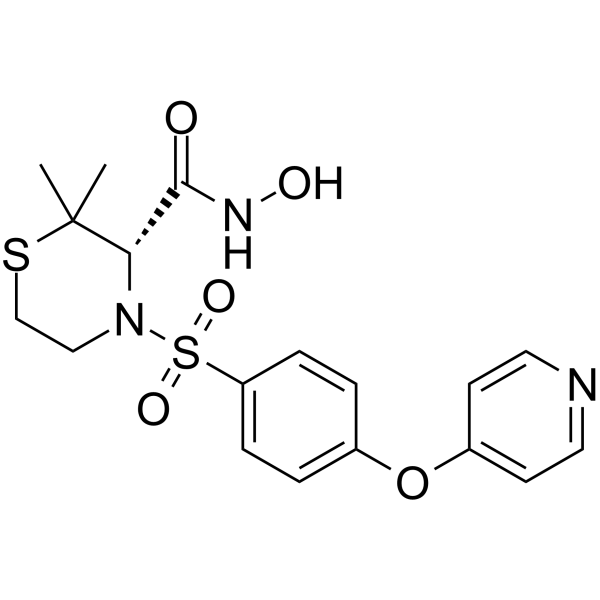
Prinomastat (AG3340) is a broad spectrum, potent, orally active metalloproteinase (MMP) inhibitor with IC50s of 79, 6.3 and 5.0 nM for MMP-1, MMP-3 and MMP-9, respectively. Prinomastat inhibits MMP-2, MMP-3 and MMP-9 with Kis of 0.05 nM, 0.3 nM and 0.26 nM, respectively. Prinomastat crosses blood-brain barrier. Antitumor avtivity[1][2][3][4].
IC50 & Target[1][4]
MMP-9
5 nM (IC50)
MMP-9
0.26 nM (Ki)
MMP-2
0.05 nM (Ki)
MMP-1
79 nM (IC50)
MMP-3
6..3 nM (IC50)
MMP-3
0.3 nM (Ki)
体外研究 (In Vitro)
Prinomastat (AG3340; 0.1-1 µg/mL; 4 days; C57MG/Wnt1 cells) inhibits Wnt1-induced MMP-3 production. Reversal of Wnt1-induced EMT and β-catenin transcriptional activity by Prinomastat[1]. Co-culture of L/Wnt3a cells and CT7 cells increases the Topflash activity in CT7 cells, and co-culturing both L/Wnt3a cells and MMP-3 overexpressing C57MG cells with CT7 cells increases the Topflash luciferase activity in CT7 cells beyond the level observed with L/Wnt3a cells, and these effects are all suppressed by Prinomastat (AG3340)[1]. Inhibition of entry of C57MG/Wnt1 cells into S phase by Prinomastat corresponds to a decrease in expression of cyclin D1 and Erk1/2 phosphorylation. The effect of Prinomastat on Wnt1-induced migration is then examined using an in vitro wound assay. As anticipated, the migration of C57MG/Wnt1 cells is increased by 1.8-fold when compared with C57MG cells.The effect of Wnt1 on the cellular distribution of vimentin is reversed by Prinomastat in C57MG/Wnt1 cells[1].
上海金畔生物科技有限公司 has not independently confirmed the accuracy of these methods. They are for reference only.
Western Blot Analysis[1]
Cell Line:
C57MG/Wnt1 cells
Concentration:
0.1 µg/mL, 1 µg/mL
Incubation Time:
4 days
Result:
A significant decrease in MMP-3 promoter activity in C57MG/Wnt1 cells.
体内研究 (In Vivo)
In a human fibrosarcoma mouse model (HT1080), the mice are treated therapeutically for 14-16 days with 50 mg/kg/day ip daily starting day 3 to 6 after tumour inoculation. Prinomastat is well tolerated by the animals, and there are no signs of weight loss or other adverse effects. Prinomastat has good tumour growth inhibition, with a short T1/2 of 1.6 hours[1].
上海金畔生物科技有限公司 has not independently confirmed the accuracy of these methods. They are for reference only.
Clinical Trial
分子量
423.51
Formula
C18H21N3O5S2
CAS 号
192329-42-3
中文名称
普啉司他
运输条件
Room temperature in continental US; may vary elsewhere.
储存方式
Powder
-20°C
3 years
4°C
2 years
In solvent
-80°C
6 months
-20°C
1 month
参考文献
[1]. Sørensen MD, et al. Cyclic phosphinamides and phosphonamides, novel series of potent matrix metalloproteinase inhibitors with antitumour activity. Bioorg Med Chem. 2003 Dec 1;11(24):5461-84.
[2]. Blavier L, et al. Stromelysin-1 (MMP-3) is a target and a regulator of Wnt1-induced epithelial-mesenchymal transition (EMT). Cancer Biol Ther. 2010 Jul 15;10(2):198-208.
[3]. Shalinsky DR, et al. Broad antitumor and antiangiogenic activities of AG3340, a potent and selective MMP inhibitor undergoing advanced oncology clinical trials. Ann N Y Acad Sci. 1999 Jun 30;878:236-70.
[4]. Ozerdem U, et al. The effect of prinomastat (AG3340), a potent inhibitor of matrix metalloproteinases, on a subacute model of proliferative vitreoretinopathy. Curr Eye Res. 2000 Jun;20(6):447-53.
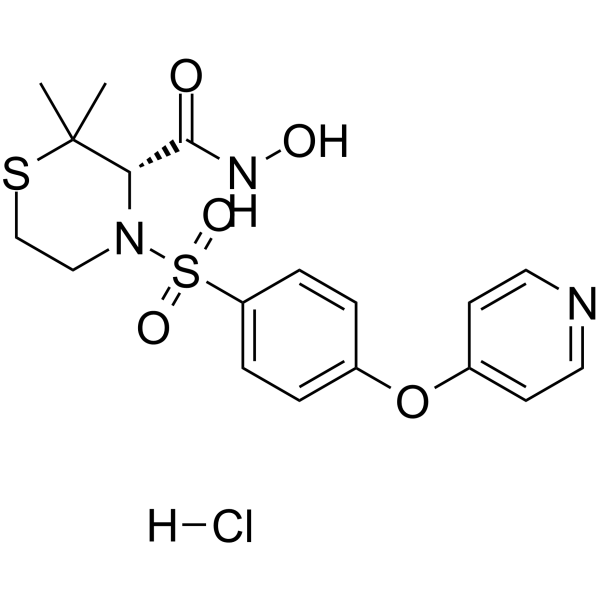
Prinomastat hydrochloride (AG3340 hydrochloride) is a broad spectrum, potent, orally active metalloproteinase (MMP) inhibitor with IC50s of 79, 6.3 and 5.0 nM for MMP-1, MMP-3 and MMP-9, respectively. Prinomastat hydrochloride inhibits MMP-2, MMP-3 and MMP-9 with Kis of 0.05 nM, 0.3 nM and 0.26 nM, respectively. Prinomastat hydrochloride can cross blood-brain barrier. Antitumor avtivity[1][2][3][4].
Prinomastat (AG3340; 0.1-1 µg/mL; 4 days; C57MG/Wnt1 cells) inhibits Wnt1-induced MMP-3 production. Reversal of Wnt1-induced EMT and β-catenin transcriptional activity by Prinomastat[1]. Co-culture of L/Wnt3a cells and CT7 cells increases the Topflash activity in CT7 cells, and co-culturing both L/Wnt3a cells and MMP-3 overexpressing C57MG cells with CT7 cells increases the Topflash luciferase activity in CT7 cells beyond the level observed with L/Wnt3a cells, and these effects are all suppressed by Prinomastat (AG3340)[1]. Inhibition of entry of C57MG/Wnt1 cells into S phase by Prinomastat corresponds to a decrease in expression of cyclin D1 and Erk1/2 phosphorylation. The effect of Prinomastat on Wnt1-induced migration is then examined using an in vitro wound assay. As anticipated, the migration of C57MG/Wnt1 cells is increased by 1.8-fold when compared with C57MG cells.The effect of Wnt1 on the cellular distribution of vimentin is reversed by Prinomastat in C57MG/Wnt1 cells[1].
上海金畔生物科技有限公司 has not independently confirmed the accuracy of these methods. They are for reference only.
Western Blot Analysis[1]
Cell Line:
C57MG/Wnt1 cells
Concentration:
0.1 µg/mL, 1 µg/mL
Incubation Time:
4 days
Result:
A significant decrease in MMP-3 promoter activity in C57MG/Wnt1 cells.
体内研究 (In Vivo)
In a human fibrosarcoma mouse model (HT1080), the mice are treated therapeutically for 14-16 days with 50 mg/kg/day ip daily starting day 3 to 6 after tumour inoculation. Prinomastat is well tolerated by the animals, and there are no signs of weight loss or other adverse effects. Prinomastat has good tumour growth inhibition, with a short T1/2 of 1.6 hours[1].
上海金畔生物科技有限公司 has not independently confirmed the accuracy of these methods. They are for reference only.
Clinical Trial
分子量
459.97
Formula
C18H22ClN3O5S2
CAS 号
1435779-45-5
运输条件
Room temperature in continental US; may vary elsewhere.
[1]. Sørensen MD, et al. Cyclic phosphinamides and phosphonamides, novel series of potent matrix metalloproteinase inhibitors with antitumour activity. Bioorg Med Chem. 2003 Dec 1;11(24):5461-84.
[2]. Blavier L, et al. Stromelysin-1 (MMP-3) is a target and a regulator of Wnt1-induced epithelial-mesenchymal transition (EMT). Cancer Biol Ther. 2010 Jul 15;10(2):198-208.
[3]. Shalinsky DR, et al. Broad antitumor and antiangiogenic activities of AG3340, a potent and selective MMP inhibitor undergoing advanced oncology clinical trials. Ann N Y Acad Sci. 1999 Jun 30;878:236-70.
[4]. Ozerdem U, et al. The effect of prinomastat (AG3340), a potent inhibitor of matrix metalloproteinases, on a subacute model of proliferative vitreoretinopathy. Curr Eye Res. 2000 Jun;20(6):447-53.